KenjutsuWorld Original Series
School #1 of 10 — The Lineages That Shaped the Sword
Tenshin Shōden Katori Shintō-ryū
天真正伝香取神道流
“Direct and Authentic Transmission from the Deities”
The Oldest Sword School Still Alive
Before Musashi. Before the Shinsengumi. Before the Tokugawa shogunate transformed Japan into centuries of relative peace — there was Katori Shintō-ryū. Founded around 1447 in the Muromachi period, it is widely recognized as the oldest extant school of Japanese martial arts. While empires rose and fell and the samurai class eventually disappeared, this single tradition kept its flame burning. It burns still today.
To study Katori Shintō-ryū is to hold something genuinely ancient in your hands. Every cut, every kata, every principle in the curriculum connects back to a time when these techniques were battlefield tools — not sport, not ceremony, but survival.
The Founder’s Legend
Iizasa Chōisai Ienao was born around 1387 in Shimōsa Province — present-day Chiba Prefecture. A respected warrior and spearman, he served the Chiba clan until his lord was deposed and his world collapsed. Rather than seeking revenge or another master, he did something extraordinary: he withdrew.
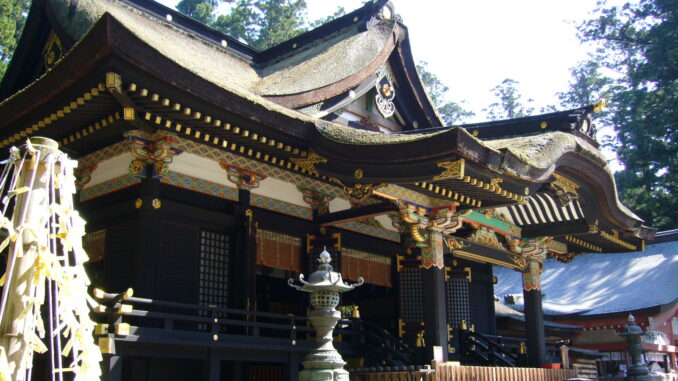
Around the age of sixty, Iizasa settled near the sacred Katori Shrine and undertook a thousand days of prayer, fasting, and intensive martial training in isolation — a feat of discipline that is difficult to fully comprehend. At the end of those thousand days, tradition holds that the deity of the shrine, Futsunushi-no-Kami, appeared to him in the form of a small boy atop an old plum tree and declared: “Thou shalt be the master of all the swordsmen under the sun.” The deity presented him with a divine scroll containing the secrets of martial strategy.
Whether one reads this as literal divine encounter or as the metaphor of a man pushing himself to transcendence, the result was the same: a comprehensive martial system unlike anything before it. Iizasa named it Tenshin Shōden — “direct and authentic transmission from the deities” — in honor of the Katori Shrine. He is said to have lived to the age of 102.
“A man who undertakes a thousand days of isolation, prayer, and training is not seeking technique. He is seeking transformation. Whatever he found in those thousand days, Katori Shintō-ryū was the result.”
What the School Teaches
Katori Shintō-ryū is not merely a kenjutsu school — it is a complete martial system. The curriculum encompasses kenjutsu (swordsmanship), battōjutsu (sword drawing), bōjutsu (staff), naginatajutsu (glaive), sōjutsu (spear), shurikenjutsu (throwing blades), and jūjutsu. This breadth reflects its origins: a battlefield system designed for warriors wearing 35 kg of armor, fighting on uneven terrain, in any weather, against any weapon.
The body mechanics and posture of Katori are notably distinct from later schools — deliberately adapted to fighting in heavy armor. The O-yoroi armor of the period weighed up to 30 kg, constructed from thousands of lacquered steel scales laced together with silk and hemp. You can still see this difference when comparing its kata to more fluid Edo-period schools. The past is visible in the movement itself.
Its Legacy in Japanese Martial Arts
Some of the most legendary swordsmen in history trained here or traced lineage through here. Its reach into what came after is immense:
- Tsukahara Bokuden — the undefeated duelist who later founded Kashima Shintō-ryū — trained in Katori in his youth.
- Kashima Shintō-ryū and by extension Shinkage-ryū trace their roots through this lineage.
- Yagyū Shinkage-ryū — the sword school of the Tokugawa shogunate — is listed among its descendant schools.
- In 1960, Katori Shintō-ryū became the first martial school designated as an Intangible Cultural Asset by the Japanese government.
- It is currently transmitted under the 20th-generation headmaster, Yasusada Iizasa — a direct descendant of the founder.
Why It Still Matters
There is a Japanese concept — issha zetsumei — that means to give everything, to leave nothing behind. Katori Shintō-ryū embodies something like this. It wasn’t preserved through institutional support or government programs. It survived because each generation of practitioners chose to carry it forward, through war, political upheaval, modernization, and the complete transformation of Japanese society.
Nearly six hundred years after Iizasa first raised a sword near that shrine, practitioners around the world — Japan, Europe, Brazil, the United States — are still training in the system he built. That alone is worth contemplating the next time you step on the mat.
This is Post 1 of 10 in our series: The Lineages That Shaped the Sword.
Next week: Kashima Shintō-ryū — the undefeated duelist who built his school on 100 victories.
Follow along at KenjutsuWorld.com
Sources & Further Reading
- Draeger, Donn F. — Classical Bujutsu: The Martial Arts and Ways of Japan, Vol. 1 (Weatherhill, 1973). The foundational English-language study of koryu martial arts and their lineages.
- Otake, Risuke — The Deity and the Sword: Katori Shinto-ryu, Vols. 1–3 (Minato Research, 1977). Written by the 20th-generation headmaster; the definitive primary source on the school’s history and curriculum.
- Friday, Karl F. — Legacies of the Sword: The Kashima-Shinryu and Samurai Martial Culture (University of Hawaii Press, 1997). Rigorous academic treatment of koryu lineage and transmission.
- Mol, Serge — Classical Fighting Arts of Japan: A Complete Guide to Koryu Jujutsu (Kodansha, 2001). Comprehensive overview of koryu schools and their relationships.
- Agency for Cultural Affairs, Japan — Tenshin Shōden Katori Shintō-ryū designated as an Intangible Cultural Asset, 1960. bunka.go.jp
- O-Yoroi Armor Weight — Museum records, Metropolitan Museum of Art; and Japanese Armor Weight, Gunbai Military History (gunbai-militaryhistory.blogspot.com, 2017). O-yoroi full sets documented at approximately 25–30 kg.
- Tozando Martial Arts — Japanese Samurai Armor 101. weblog.tozando.com. Overview of O-yoroi and tōsei gusoku construction and use periods.
Share this:
- Share on Facebook (Opens in new window) Facebook
- Share on LinkedIn (Opens in new window) LinkedIn
- Share on Pinterest (Opens in new window) Pinterest
- Share on X (Opens in new window) X
- Share on Reddit (Opens in new window) Reddit
- Share on Tumblr (Opens in new window) Tumblr
- Email a link to a friend (Opens in new window) Email
- Print (Opens in new window) Print
Leave a Reply