KenjutsuWorld Original Series
School #7 of 10 — The Lineages That Shaped the Sword
Jigen-ryū
示現流
“The School of Sudden Revelation”
Every school we have covered in this series has a defining characteristic — a philosophy, an innovation, a lineage, a text. Jigen-ryū’s defining characteristic is simpler and more visceral than any of them: it is the most ferociously aggressive classical sword school in the history of Japanese martial arts. Where other schools balanced attack and defence, technique and strategy, Jigen-ryū believed in one thing above all else — the first strike must end the fight. There is no second strike. There should never need to be one.
Among the samurai who encountered Satsuma warriors trained in this school, a saying circulated: “Do not face a Jigen-ryū practitioner even with a spear.” The most authoritative version of this warning came from Kondō Isami — the legendary commander of the Shinsengumi — who instructed his own elite swordsmen: “If it is the first strike of a Satsuma swordsman, dodge it; do not attempt to parry.” That a man who commanded some of the finest sword fighters of the Bakumatsu era felt it necessary to give this specific instruction tells you everything about how Jigen-ryū was regarded. That reputation was earned across three centuries of real combat — and the warriors who built the Meiji Restoration carried this school’s technique into every confrontation that ended an era.
Tōgō Shigekata was born around 1560–1561 in Satsuma Domain — modern-day Kagoshima Prefecture, at the southernmost tip of Kyushu. He began martial training at the age of seven in Taisha-ryū, the sword school of the Shimazu clan, and received full initiation into its secrets in his early twenties. His first battlefield experience came at 17 or 18 at the Battle of Mimigawa in 1578, fighting for the Shimazu clan against the Ōtomo from Bungo Province.
The transformation came in 1587–1588, when he accompanied Shimazu Yoshihisa to Kyoto. There he encountered a Buddhist monk named Zenkichi — also known as Terasaka Yakuro Masatsune — who was rumored to be an expert in a little-known style called Tenshinsho Jigen-ryū. Tōgō challenged him to a duel. He lost. He persuaded the monk to teach him anyway, and spent the next six months in intensive training before returning to Satsuma.
Back in Satsuma, Tōgō combined his mastery of Taisha-ryū with his newly acquired Tenshinsho Jigen-ryū and undertook a period of intense ascetic practice — shugyō — including undefeated duels and solitary reflection. The turning point came while meditating on a passage from the Lotus Sutra — the phrase jigen jintsuriki, meaning “a sudden revelation of divine power.” He changed the characters of his school’s name from the older jigen (自顕, “self-power revelation”) to the Buddhist-inflected jigen (示現, “sudden revelation”) — and Jigen-ryū as we know it was born. By 1604, at the age of roughly 44, he had become the chief swordsmanship instructor for the entire Satsuma domain.
“If it is the first strike of a Satsuma swordsman, dodge it; do not attempt to parry.”
— Kondō Isami, commander of the Shinsengumi, warning his elite swordsmen about Jigen-ryū practitionersJigen-ryū is built around a single foundational concept: yōichi no tachi — the first sword wins. The school teaches that in real combat, an opponent who absorbs your first strike and can still fight is an opponent who will kill you. Therefore, the first strike must be absolute — delivered with total body commitment, total speed, and total power.
Tonbo-no-Kamae
The “dragonfly stance” — sword held raised overhead, almost vertical. An unusual, committed position that channels maximum downward force into the first cut. No defensive guard. No hedging. Pure offence.
Tachikiuchi
The signature training method — striking a wooden post or pine tree thousands of times with a wooden sword. Not to simulate cutting technique, but to condition the body and spirit to deliver absolute, committed power every single time.
The school’s training methodology is notably different from other koryu. Where most schools train through kata — partnered forms — Jigen-ryū places extraordinary emphasis on solo repetitive striking, particularly tachikiuchi: striking a vertical wooden post or tree with a heavy wooden sword, accompanied by the school’s distinctive battle cry. The numbers are staggering — dedicated practitioners were historically expected to complete 3,000 strikes in the morning and 8,000 strikes in the afternoon, every day. The purpose is not technical refinement — it is the forging of a body and mind that delivers absolute, committed power without hesitation, strike after strike after strike.
The kiai of Jigen-ryū — and particularly of its Yakumaru branch — has a specific historical name: Enkyō (猿叫), meaning “Monkey’s Scream.” Contemporary observers described the sound as resembling a chicken being strangled — an unsettling, high-pitched shriek unlike anything heard in other martial arts. It was designed to shatter an opponent’s concentration before the first cut landed — and historical accounts suggest it succeeded.
To understand Jigen-ryū is to understand Satsuma. The Shimazu clan’s domain in southern Kyushu was one of the most militaristic in all of feudal Japan — isolated by geography, proud of its independence, and famous for a warrior culture that emphasized discipline, frugality, and martial intensity above all else. The Satsuma samurai occupied a unique position: even during the enforced peace of the Tokugawa era, Satsuma maintained a semi-autonomous martial culture that kept training genuinely serious.
Jigen-ryū was not merely a sword school in Satsuma — it was the official sword school of the Shimazu domain, taught in the gojū system of communal youth martial education. And crucially, it was an odome-ryū (御留流) — a “forbidden school.” The Shimazu clan strictly prohibited the teaching of Jigen-ryū to anyone outside the Satsuma domain, under penalty of death. This secrecy is precisely why the school remained so mysterious and terrifying to the rest of Japan for two and a half centuries — and why, when Satsuma warriors finally appeared on the national stage during the Bakumatsu period, their swordsmanship seemed to come from nowhere. Every samurai family in Satsuma trained in it. Boys began tachikiuchi long before they understood the philosophy behind it. The result was a domain-wide culture of aggressive, committed swordsmanship that set Satsuma warriors apart from every other samurai in Japan.
A related school, Yakumaru Jigen-ryū, descended from Jigen-ryū and integrated the Yakumaru family’s nodachi (long sword) techniques. When Lord Shimazu Narioki once observed a Yakumaru training session, he reportedly left the room saying: “This is nothing but the swordsmanship of a madman.”
This is where Jigen-ryū’s story intersects with one of the most pivotal moments in modern Japanese history. The men who overthrew the Tokugawa shogunate in 1868 and engineered the Meiji Restoration were disproportionately Satsuma samurai — and Satsuma samurai were trained in Jigen-ryū and its Yakumaru branch from childhood.
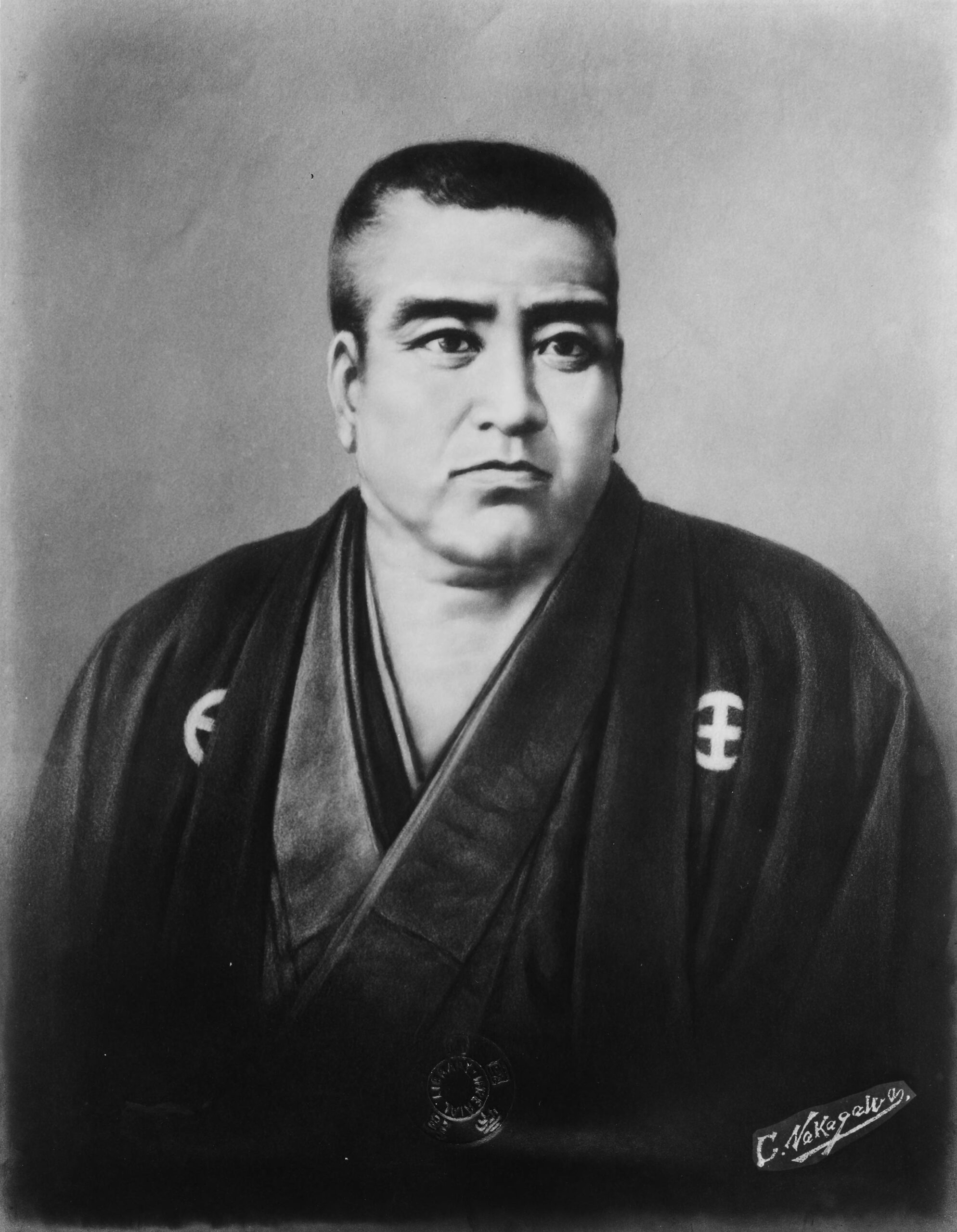
The most famous is Saigō Takamori — one of the three great heroes of the Meiji Restoration, later known as “the last samurai” for leading the Satsuma Rebellion of 1877 against a Meiji government he felt had betrayed the samurai class it had risen on. Saigō was a practitioner of the Yakumaru Jigen-ryū branch and embodied its philosophy of total commitment — an all-or-nothing approach to conflict that defined both his role in the Restoration and his final stand at the Battle of Shiroyama, where he was mortally wounded and reportedly committed seppuku.
His childhood friend and fellow Satsuma warrior Ōkubo Toshimichi — who went on to become one of the most powerful political architects of the Meiji government — also trained in the same school. Two men who shaped the birth of modern Japan, forged in the same aggressive, uncompromising martial tradition.
The school that produced the samurai who dismantled feudal Japan also produced the samurai who fought hardest to preserve it. Saigō Takamori used Jigen-ryū’s philosophy of total commitment to overthrow the shogunate — and then used that same philosophy to lead the last samurai rebellion against the modernization that followed. The school’s ethos contained no half-measures either way.
- The official sword school of the Shimazu clan — and an odome-ryū (御留流), a “forbidden school” whose teaching outside Satsuma was prohibited under penalty of death, keeping it mysterious to the rest of Japan for 250 years
- Saigō Takamori and Ōkubo Toshimichi — two of the principal architects of the Meiji Restoration — were trained in the Jigen-ryū tradition through the Yakumaru branch
- The tachikiuchi training method — solo striking of posts and trees — became one of the most distinctive and recognizable training images in Japanese martial arts
- Yakumaru Jigen-ryū, the most aggressive branch, produced some of the most feared swordsmen of the late Tokugawa period — and several key figures of the Ishin Shishi, the pro-imperial activists who toppled the shogunate
- Still actively practiced in Kagoshima today — demonstrations are held annually at Kagoshima’s Terukuni Shrine, making it one of the few koryu schools with a continuous, unbroken public tradition of shrine demonstration
- Current headmaster: Tōgō Shigenori — a direct descendant of the founder, carrying the name forward into the 21st century
Every school in this series represents a different answer to the same question: what is the sword for? Katori Shintō-ryū says the sword is for comprehensive battlefield readiness. Shinkage-ryū says the sword is for life-giving strategy. Yagyū Shinkage-ryū says the sword is for wisdom and governance. Musashi says the sword is for transcendence through discipline.
Jigen-ryū says the sword is for ending a fight before it begins. That might sound crude — and in the context of a philosophy seminar, perhaps it is. But in the context of three centuries of real Satsuma combat, and in the hands of the men who ended the Tokugawa era and transformed Japan into the country it became, it was the most practical answer anyone gave.
The warriors who built modern Japan swung wooden swords at pine trees every morning before anyone else in the domain was awake. That is Jigen-ryū’s enduring image — and its enduring truth.
- — jigen-ryu.com/index_e.html. The authoritative account of Tōgō Shigekata’s biography, the meeting with Zenkichi, and the school’s founding. Used as primary source for biographical detail.
- — en.wikipedia.org/wiki/Jigen-ryū. Core school details, founder biography, arts taught, and current headmaster.
- — en.wikipedia.org/wiki/Tōgō_Shigekata. Detailed biography including training lineage and the Lotus Sutra name-change inspiration.
- — en.wikipedia.org/wiki/Yakumaru_Jigen-ryū. The aggressive branch, nodachi integration, and the Shimazu Narioki “swordsmanship of a madman” account.
- — en.wikipedia.org/wiki/Saigō_Takamori. Biographical and political career detail, Satsuma Rebellion, and final stand at Shiroyama.
- — “Gojū — The Legendary Samurai Schools of Satsuma,” morethantokyo.com. Detailed account of the Satsuma gojū youth martial education system and Jigen-ryū’s role in it.
- — Encyclopedia of Japanese Martial Arts (Kodansha USA, 2012). pp. 515–516. Used for cross-referencing Zenkitsu/Terasaka Masatsune’s identity and dating.
This is Post 7 of 10 in our series: The Lineages That Shaped the Sword.
Next week: Kashima Shinden Jikishinkage-ryū — the school whose headmaster pioneered the first standardized bōgu armor, and one of the most popular sword schools of Edo-period Japan.
Follow along at KenjutsuWorld.com
Leave a Reply