KenjutsuWorld Original Series
School #4 of 10 — The Lineages That Shaped the Sword
Yagyū Shinkage-ryū
柳生新陰流
“The Sword of the Shogunate”
Last week we covered Shinkage-ryū and the moment Kamiizumi Nobutsuna passed full transmission to a samurai named Yagyū Munetoshi in 1565. This week, we follow that single transmission into one of the most consequential outcomes in the history of Japanese martial arts: a sword school that didn’t just survive into the era of peace that followed the Sengoku period — it became the official martial art of the government that built that peace.
For 250 years, the men who taught swordsmanship to the Tokugawa shoguns were Yagyū family members. That is not a footnote. That is one family’s technique, philosophy, and worldview shaping the inner life of Japan’s ruling house for a quarter of a millennium.
Yagyū Munetoshi was already a respected swordsman in Yamato Province by the time Kamiizumi Nobutsuna passed through in 1563. Kamiizumi recognized something in him and stayed roughly half a year, eventually giving him an assignment: study the concept of mutō-dori — facing an armed opponent while unarmed yourself. When Munetoshi returned a year later having mastered the principle, Kamiizumi was impressed enough to award him an inka-jō — a certificate of highest attainment — along with permission to teach Shinkage-ryū in his own right.
That moment, in 1565, marks the founding of Yagyū Shinkage-ryū. Munetoshi added his family name to the school and began developing the mutō techniques further — using the empty hand against a drawn sword.
Tokugawa Ieyasu watched Munetoshi demonstrate his skill and was so impressed he asked the aging swordsman to become his personal instructor. Munetoshi, already advanced in years, made a recommendation that would alter Japanese history: his fifth son.
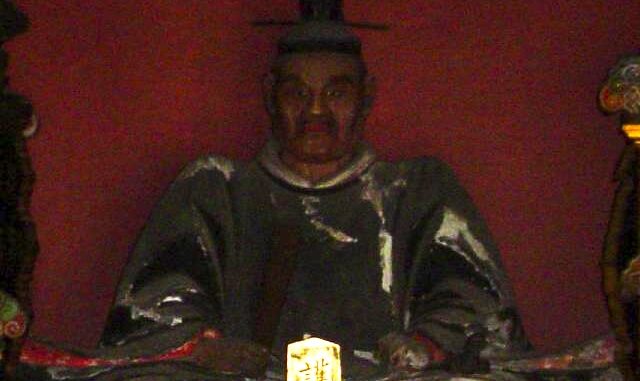
— The meeting that founded a dynasty, 1594Yagyū Munenori (1571–1646) took up his father’s recommendation and entered Tokugawa Ieyasu’s service. Six years later, in 1600, Ieyasu won the Battle of Sekigahara and became the undisputed ruler of Japan. Munenori had personally fought in that battle and in the subsequent Siege of Osaka — cutting down seven attackers single-handedly during one ambush on the shogun. He became shogunke heihō shihan — official martial arts instructor to the house of the shogun — training Ieyasu’s son Hidetada, and later the third shogun, Tokugawa Iemitsu, whom he tutored from childhood.
Munenori’s role expanded well beyond the dojo. In 1632, he was appointed ōmetsuke — head of the shogunate’s intelligence and inspection service, akin to running an internal security apparatus for the entire government — while holding an income of roughly 3,000 koku. He continued to rise, reaching the 10,000-koku threshold in 1636, which formally elevated him to daimyō status — the only swordsman of his era to be raised to feudal lord purely on the strength of his sword teaching and political service.
In that same year, 1632, Munenori completed his defining work: Heihō Kadensho — “A Hereditary Book on the Art of War,” sometimes translated as “The Life-Giving Sword.” Written for Shogun Iemitsu, the book was never intended for outside readers — it was a private family transmission text, restricted to the Yagyū lineage and select initiates. Its prestige was such that it spread throughout Japan anyway and remains, alongside Miyamoto Musashi’s Book of Five Rings, one of the two most important texts on swordsmanship and strategy in Japanese history.
Satsujin-ken
The “killing sword” — addresses force as a necessary remedy to disorder. The first of the book’s three sections.
Katsujin-ken
The “life-giving sword” — true mastery lies not in killing but in the wisdom to prevent or minimize conflict, preserving life.
The book’s third section, “No Sword,” explores using environment and positioning — terrain, weather, timing — to one’s advantage without ever drawing a blade. Deeply shaped by his friendship with the Zen monk Takuan Sōhō, Munenori wove in the concept of mushin — the empty, unattached mind — arguing that a mind fixed on winning or losing becomes trapped, while a mind free of attachment can respond to anything freely.
When Munetoshi died in 1606, the school divided into two branches that persist to this day. Munenori led the Edo branch, based in the shogun’s own capital, which took on a particularly strong Zen and strategic character befitting its role serving the ruling house directly. Munetoshi’s grandson Yagyū Toshiyoshi led the Owari branch in Nagoya, serving a cadet branch of the Tokugawa family, and preserved more of the school’s earlier technical repertoire.
Munenori’s own son, Yagyū Jūbei Mitsuyoshi, became one of the most legendary figures in the lineage — a master not only of the sword but of jūjutsu, ninjutsu, and a practitioner of musha shugyō in his own right. His sword technique was named chie-no-ken, the “sword of transcendent wisdom.” Centuries later he would become a folk hero in Japanese popular culture — often romanticized with a fictional eyepatch, his historical exploits blurred into legend.
- One of only two sword schools officially patronized by the Tokugawa shogunate — the other being Ittō-ryū
- Trained three successive shoguns — Ieyasu, Hidetada, and Iemitsu — across roughly four decades
- Heihō Kadensho remains, alongside Musashi’s Book of Five Rings, one of the two defining texts on Japanese swordsmanship and strategy
- The 5th sōke, Yagyū Toshikane (Renya), codified the school’s kata into the formal Hassei-hō curriculum and refined the fukuro-shinai — originally invented a century earlier by Kamiizumi Nobutsuna — into a shorter, thicker design for the Owari branch; Yagyū training remained primarily kata-based rather than free sparring
- True free sparring with protective armor (bogu) — the direct ancestor of modern kendō practice — was pioneered separately in the early 1700s by Naganuma Kunisato of Jikishinkage-ryū, a parallel branch descending from Kamiizumi’s original teachings
- Survived the Meiji Restoration thanks to a celebrated 1887 demonstration before Emperor Meiji, performed by 11th headmaster Yagyū Toshichika alongside his son Toshinaga; deeply impressed, the Emperor ordered Toshichika to ensure the art’s survival, and Toshinaga later fulfilled that mandate as a martial arts instructor for the Imperial Guard
- Yagyū instructors went on to teach the Tokyo Metropolitan Police and the Dai Nippon Butoku-kai, carrying the tradition into the modern era
- Both Edo and Owari branches remain active today, taught by direct descendants of the founding family
Most koryu schools survived in spite of history — preserved by small communities of devoted practitioners against the tide of modernization. Yagyū Shinkage-ryū is unusual in that for two and a half centuries, it didn’t survive in spite of power — it sat at the very center of it. Its philosophy of katsujin-ken, the life-giving sword, became not just a martial principle but a governing one, shaping how Japan’s most powerful family thought about authority, restraint, and order.
That a sword school’s deepest teaching was ultimately about when *not* to kill — articulated by the head of the shogun’s own secret police — is one of the most genuinely surprising threads running through this entire series.
- — en.wikipedia.org/wiki/Yagyū_Shinkage-ryū. Core lineage history, the Edo/Owari split, and modern transmission details.
- — en.wikipedia.org/wiki/Yagyū_Munenori. Biographical and career details, ōmetsuke appointment, and Tokugawa service record.
- — en.wikipedia.org/wiki/A_Hereditary_Book_on_the_Art_of_War. Structure and content summary of the Heihō Kadensho’s three sections.
- , trans. William Scott Wilson — The Life-Giving Sword: Secret Teachings from the House of the Shogun (Kodansha International, 2003). The definitive English translation of Heihō Kadensho.
- — “The Life-Giving Sword,” koryu.com/books/lifegivingsword. Review and context from a respected koryu practitioner and researcher, with input from the 21st-generation Yagyū Shinkage-ryū headmaster.
- — “About the Art,” tokumeikan.org. Detailed account of the Kamiizumi-to-Munetoshi transmission and the mutō-dori assignment.
- — “Yagyu Munenori,” harmonybudo.com. Biographical detail on Munenori’s military career and his relationship to Musashi as a contemporary.
Further Reading: Yagyu Munenori’s own treatise, The Book of Family Traditions on the Art of War, is included alongside Musashi’s Book of Five Rings in this Thomas Cleary translation — see our Books page for more.
This is Post 4 of 10 in our series: The Lineages That Shaped the Sword.
Next week: Ittō-ryū — the other official sword of the Tokugawa shogunate, and the ancestor of modern kendo.
Follow along at KenjutsuWorld.com
Leave a Reply