KenjutsuWorld Original Series
School #6 of 10 — The Lineages That Shaped the Sword
Hyōhō Niten Ichi-ryū
兵法二天一流
“The School of the Strategy of Two Heavens as One”
There is no figure in Japanese martial arts more famous than Miyamoto Musashi — and very few in world history who occupy quite the same position: a man whose actual biographical record is almost as extraordinary as the legend that grew around it, and who expressed his deepest understanding of his art not through a student but through a book that has never stopped being read.
The school he created, Hyōhō Niten Ichi-ryū, is in one sense the most unusual in this series: it is built around a technique that was genuinely counter-intuitive to the entire tradition of Japanese swordsmanship. While every other major school we have covered taught students to grip the katana with both hands, Musashi argued that this was unnecessarily limiting — and built a system around wielding two swords simultaneously, one in each hand.
Miyamoto Musashi was born around 1584 in Harima Province, the son of a martial artist. His early life is genuinely difficult to verify — some accounts place his first duel at the age of 13, others later. What the historical record does confirm is that he fought on the losing Toyotomi side at the Battle of Sekigahara in 1600, survived, and emerged to begin the musha shugyō that would define his life.
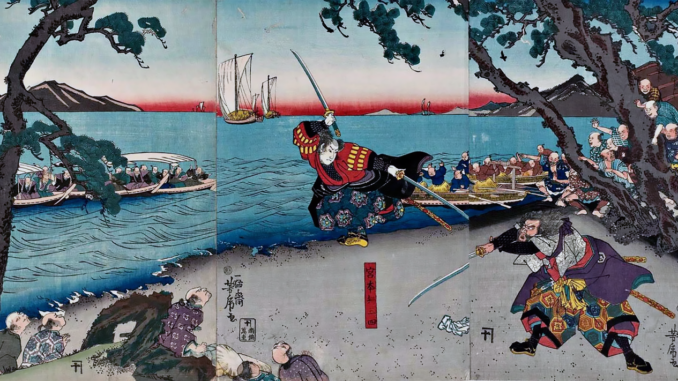
Over the following decades he fought more than 60 duels — all survived, all won. His most famous encounter was with Sasaki Kojirō in 1612 on the island of Ganryūjima: Musashi arrived late, carved a bokken from the oar of his boat on the crossing, and killed Kojirō with a single strike. The entire encounter — the lateness, the improvised weapon, Kojirō’s famous “swallow return” technique — has been told and retold across four centuries until it is almost impossible to separate history from legend. What is not in dispute is the outcome.
Around 1604–1605, at roughly 21 years old, Musashi began developing his two-sword technique. He participated in the Winter and Summer campaigns of Osaka in 1614–1615, but didn’t use his two-sword technique in formal public combat until around 1621 — a duel against Miyake Gunbei, a vassal of Honda Tadamasa and practitioner of Tōgun-ryū, in Himeji. Records note that Gunbei fought with a piece of bamboo from the garden; Musashi used a bokken. By then the technique was fully formed.
“In my strategy, one man is the same as ten thousand men. The way of the warrior is the resolute acceptance of death.”
— Miyamoto Musashi, Go Rin no Shō (The Book of Five Rings), 1645The name Niten Ichi — two heavens as one — expresses not just a technique but a philosophical orientation. Musashi rejected the idea that mastery lies in perfect command of a single weapon or single method. Real adaptability, he argued, requires fluency across multiple instruments. A swordsman who can only fight with both hands on the hilt is half a swordsman.
The school’s technical philosophy is built around five principles corresponding to the five scrolls of Go Rin no Shō: Earth (foundation and structure), Water (adaptability and fluidity), Fire (intensity and pace), Wind (understanding of other schools), and Void (the formless state of true mastery where technique becomes instinct). These are not abstract metaphors — each scroll contains specific tactical and technical content that practitioners still work through today.
Niten Ichi — Technical
Katana in the right hand, wakizashi in the left — one sword defends and controls, the other delivers the decisive strike. No wasted motion, no excess movement.
Hyōhō — Strategic
Strategy that transcends swordsmanship: timing, perception, adaptability, and the discipline to remain unattached to any single method or outcome.
Musashi was also a practitioner of Bunbu Ryōdō — the dual path of literary and martial arts. He was an accomplished painter, sculptor, and calligrapher whose artwork survives in Japanese museum collections today. His ink paintings of shrike birds and his brushwork are held in some of the same institutions that preserve his martial writings. This integration of art and martial discipline was not incidental for Musashi — he considered them expressions of the same underlying mastery.
The official curriculum of Hyōhō Niten Ichi-ryū, as preserved by the main Seito lineage, consists of four core sets of paired kata practiced with wooden swords:
All training uses wooden swords — bokken and kodachi. There is no shinai or bōgu sparring in Niten Ichi-ryū. Musashi himself gave up the live blade for a bokken in his later duels, including the famous Ganryūjima duel, and the school follows that precedent. Rather than grading by rank, the school uses the traditional menkyo scroll transmission system — each scroll representing mastery of a specific set of techniques.
A week before his death from thoracic cancer in May 1645, Musashi passed his core teachings — the Hyōhō Sanjūgo Kajō (35 Articles of Strategy) — to his senior student Terao Magonojo. He also presented Terao with his two swords and a certificate of transmission. Magonojo died before fully passing on the teachings; his younger brother Terao Kyūmanosuke took over the school’s leadership and transmitted the lineage forward.
Shortly before his death, Musashi also completed Go Rin no Shō — The Book of Five Rings — writing it in a cave called Reigandō over a period of roughly two years. The book was written not as a public text but as a private transmission for his students. Like Yagyū Munenori’s Heihō Kadensho from the previous week, it spread far beyond its intended audience and has never stopped being read — today it is studied by business executives, military officers, and strategists worldwide alongside Sun Tzu’s Art of War.
Hyōhō Niten Ichi-ryū has transmitted through multiple branches over four centuries, some diverging due to geography, succession disputes, or teaching priorities. Two deserve particular mention:
- Seito (main) line — traces directly from Musashi through the Terao brothers to modern times; currently under 12th sōke Kajiya Takanori, recognized by the Nihon Kobudō Kyōkai and Nihon Kobudō Shinkōkai as the legitimate main line; hombu dōjō in Kokura (Kitakyushu City), where an annual demonstration is held before the monument to Musashi
- Gosho-ha / Noda-ha lines — independent branches with their own lineages; the Gosho-ha under 12th sōke Yoshimochi Kiyoshi (son of the late Gosho Motoharu, shihan of generations 10–12) traces through the 8th sōke Noriyuki Aoki; the Noda-ha is particularly noted for preserving the Gohō-no-tachi five two-sword forms
- Active dojos transmitting the school today span Japan, Brazil, Ireland, and the United States — making this one of the more internationally practiced koryu schools in the series
- Go Rin no Shō — written weeks before Musashi’s death in 1645 — remains one of the most widely read strategic texts in the world, studied far beyond martial arts
- Musashi is designated a kensei — sword saint — one of only a handful of swordsmen in Japanese history to receive this honorific
- His artwork survives in Japanese museum collections — ink paintings and calligraphy held alongside his martial writings as expressions of a unified mastery
- The two-sword technique he codified appears in modern kendō’s kata and in naginata competition rules permitting two-weapon engagement
- The Dokkōdō — “The Way of Walking Alone” — written days before his death, lays out 21 precepts for living. Still studied as a philosophical text today
- The monument to Musashi in Kokura, where the hombu dōjō performs annually, carries the inscription he carved on his own bokken: Seishin Chokudo — earnest heart, straight way
Every school in this series has something that makes it irreplaceable. Katori Shintō-ryū has age. Kashima Shintō-ryū has the unbeaten record. Shinkage-ryū has the innovations. Yagyū Shinkage-ryū has the philosophy of governance. Ittō-ryū has the path to kendō.
Hyōhō Niten Ichi-ryū has Musashi — a figure so compelling that four centuries of novelists, filmmakers, and martial artists have never exhausted the material. But beneath the legend is something genuinely worth studying: a man who looked at an entire tradition, found it unnecessarily limiting, and built something new from first principles. The two-sword technique was radical in the 1600s. The philosophy behind it — adaptability over dogma, fluency over specialization, the void beyond technique — remains radical today.
He wrote the book that defined Japanese swordsmanship strategy while dying of cancer in a cave. That’s not legend. That’s the record.
- , trans. William Scott Wilson — The Book of Five Rings (Go Rin no Shō) (Shambhala, 2002). The primary text — Wilson’s translation is the most historically grounded English version.
- , trans. William Scott Wilson — The Dokkōdō (The Way of Walking Alone) (2004). The 21 precepts written days before Musashi’s death.
- — en.wikipedia.org/wiki/Niten_Ichi-ryū. Lineage details, curriculum, branch distinctions between Seito, Gosho-ha, and Noda-ha.
- — en.wikipedia.org/wiki/Miyamoto_Musashi. Biographical detail, duel history, and the Ganryūjima account.
- — “Hyoho Niten Ichi Ryu: The Sword Style of Miyamoto Musashi,” way-of-the-samurai.com. Detailed technical overview written with permission from 12th sōke Kajiya Takanori.
- — “Niten Ichi Ryu,” kamusokai.com/niten. Training description from a dojo in direct lineage from 10th sōke Imai Masayuki Nobukatsu.
- — niten.org. Gosho-ha lineage information and curriculum overview under 12th sōke Yoshimochi Kiyoshi.
- — “Miyamoto Musashi and Niten Ichi-ryū’s Continued Lineage,” fightlibrary.substack.com. The succession from Magonojo to Kyūmanosuke and the 20th-century transmission through Noriyuki Aoki.
Further Reading: Miyamoto Musashi’s own The Book of Five Rings is the definitive primary source on Niten Ichi-ryū strategy — see our Books page for recommended translations.
This is Post 6 of 10 in our series: The Lineages That Shaped the Sword.
Next week: Jigen-ryū — the ferociously aggressive school of Satsuma, whose warriors led the Meiji Restoration.
Follow along at KenjutsuWorld.com
Leave a Reply