KenjutsuWorld Original Series
School #2 of 10 — The Lineages That Shaped the Sword
Kashima Shintō-ryū
鹿島新當流
“The School of the Sword Saint”
If Katori Shintō-ryū is the oldest sword school, Kashima Shintō-ryū is the one built on the most extraordinary combat record in Japanese history. Its founder, Tsukahara Bokuden, fought 19 duels — and won every single one. He survived 37 battles. He accumulated an estimated 212 kills. He was wounded six times — all by arrows. Not once did an opponent’s blade touch him.
He lived to 82 years old, dying of natural causes in 1571. History gave him a title reserved for only the greatest: kensei — sword saint.
Bokuden was born in 1489 into the Yoshikawa family — hereditary custodians of the Kashima Grand Shrine in what is now Ibaraki Prefecture. His bloodline carried both martial arts and Shinto divination. He was adopted at age 10 by the Tsukahara clan and took their name.
His training began immediately in two traditions: Kashima Chūkō-ryū from his birth father, and Tenshin Shōden Katori Shintō-ryū from his adoptive father — the same school we covered last week, tracing back to Iizasa Chōisai Ienao. By 17, he had mastered both. By 20, he killed his first opponent in a duel after being ambushed.
What set Bokuden apart was his commitment to musha shugyō — the warrior’s ascetic pilgrimage. Rather than settle into a comfortable life as a skilled swordsman, he traveled Japan three times over, seeking out the best fighters the country had to offer and testing himself against them.
His first pilgrimage (1505–1518) built the record. He challenged masters, defeated all of them, survived full battlefield combat, and emerged without a single sword wound. His second pilgrimage came later in life — this time not to challenge, but to teach. By then, his reputation was such that shoguns and daimyō summoned him to their courts. Ashikaga Yoshiteru, the ruling shogun, studied under him at age 17. Takeda Shingen — one of the great warlords of the era — hired him to train his generals.
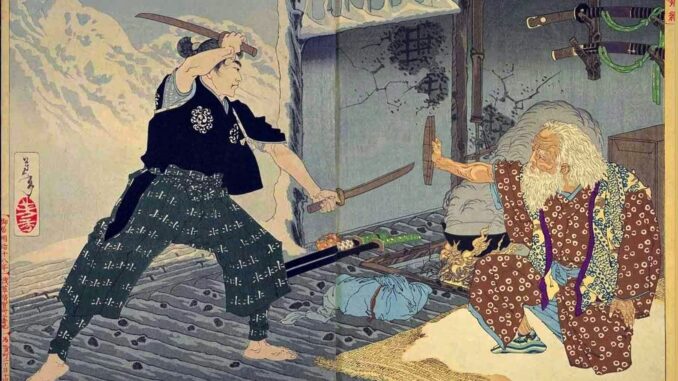
“When asked his style, Bokuden replied: ‘I study the Style of No Sword.’ The ruffian laughed — until Bokuden rowed the boat away and left him stranded on the island, sword in hand, with no one to fight.”
The most remarkable thing about Tsukahara Bokuden is not his kill record — it’s what he came to believe in his later years. After a lifetime of combat, he arrived at a philosophy almost unheard of in his era: that avoiding conflict altogether was superior to winning it.
He called one version of his system Mutekatsu-ryū — “winning without hands.” The boat story above is the most famous illustration: the truest mastery of the sword is knowing when not to draw it. This idea became foundational to how Kashima Shintō-ryū understands strategy — not just technique, but the mind behind the technique.
After receiving divine inspiration from Takemikazuchi-no-Kami, the deity of Kashima Shrine, he named his systematized school Kashima Shintō-ryū and spent his final years in a mountain sanctuary where students came from across Japan to study under him.
Kashima Shintō-ryū is built around the Ichi no Tachi — the “first sword” — a principle of decisive, singular action that ends a confrontation before it escalates. The curriculum covers:
- Kenjutsu (ōdachi & kodachi) — long and short sword techniques
- Bōjutsu — staff art
- Sōjutsu — spear art
- Naginatajutsu — glaive art
- Traces its roots to Katori Shintō-ryū — the school founded by Iizasa Chōisai Ienao (School #1 in this series)
- Kamiizumi Nobutsuna — founder of Shinkage-ryū (School #3) — was a younger contemporary of Bokuden, both trained in the Kashima tradition and operating in the same era of Japanese swordsmanship
- Tennen Rishin-ryū — the style of the legendary Shinsengumi — descends from this lineage
- Yamaguchi-ryū also traces its roots here
- Bokuden’s emphasis on strategy over technique influenced every major sword school that followed him
- The Kashima Shrine remains, to this day, a pilgrimage site for Japanese swordsmen — considered the spiritual home of kenjutsu
Tsukahara Bokuden lived in one of Japan’s most violent eras — the Sengoku period, a century of near-constant civil war. He fought its best warriors, survived its worst battles, and came out the other side having concluded that wisdom was greater than victory.
That arc — from the undefeated duelist to the philosopher who preferred to leave his opponent stranded on an island rather than kill him — is the arc of a man who genuinely mastered his art. Kashima Shintō-ryū carries both sides of that legacy: the technical precision that made him unbeatable, and the philosophy that made him worth remembering 500 years later.
- — Miyamoto Musashi: His Life and Writings (Shambhala, 2004). Contains the most historically grounded account of Bokuden’s duel record and biographical details.
- — Legacies of the Sword: The Kashima-Shinryu and Samurai Martial Culture (University of Hawaii Press, 1997). Note: Friday’s book focuses specifically on Kashima Shinden Jikishinkage-ryū — a distinct school sharing Kashima shrine origins — rather than Kashima Shintō-ryū directly. Nonetheless an invaluable academic resource for understanding the broader Kashima sword tradition and culture.
- — Classical Bujutsu: The Martial Arts and Ways of Japan, Vol. 1 (Weatherhill, 1973). Foundation English-language overview of koryu schools including Kashima Shintō-ryū.
- — “Kashima Shinto-ryu” by Matthew Skoss. koryu.com/library/mskoss3. Detailed lineage history and school overview from a respected koryu practitioner resource.
- — “Tsukahara Bokuden.” budo-world.taiiku.tsukuba.ac.jp. Academic profile of Bokuden compiled by Tsukuba University’s martial arts research division.
- — “Kashima Shintō-ryū” and “Tsukahara Bokuden.” en.wikipedia.org. Used for factual cross-reference on dates, lineage, and students.
Further Reading: For a deeper academic look at Kashima-Shinryū specifically, see Legacies of the Sword by Karl Friday and Seki Humitake — see our Books page for more.
This is Post 2 of 10 in our series: The Lineages That Shaped the Sword.
Next week: Shinkage-ryū — the school of “the new shadow,” founded by Bokuden’s greatest student.
Follow along at KenjutsuWorld.com
Leave a Reply