KenjutsuWorld Original Series
School #10 of 10 — The Lineages That Shaped the Sword
Tennen Rishin-ryū
天然理心流
“The School of Natural Principles and True Heart”
We have traveled from 1447 to the present through nine sword schools. We end where Japanese martial arts history reaches its most dramatic final act: the Bakumatsu period, the collapse of the Tokugawa shogunate, and the men who fought — and died — to hold it together. Tennen Rishin-ryū is the school they carried into that fight.
No other school in this series has generated more novels, films, manga, video games, and television dramas than this one. The Shinsengumi — the elite pro-shogunate police corps who patrolled Kyoto during the turbulent final decade of the Edo period — have become one of the most enduring romantic figures in Japanese cultural memory. And the sword tradition that shaped their fighting was Tennen Rishin-ryū.
Kondō Kuranosuke Nagahiro came from Tōtōmi Province (modern western Shizuoka Prefecture). The details of his early life are sparse — even his birth year is unrecorded. What we know is that he undertook an extensive musha shugyō, training across Japan and eventually joining the Kashima Shintō-ryū tradition (School #2 in this series). Despite likely being on track for a teaching position there, he left to create something new.
What drove him was a recognition that Japanese swordsmanship was at a turning point. The rigid katageiko (form practice with bokutō or dull-edged swords) that had characterized classical training was giving way to shinaigeiko — free practice with bamboo swords and protective armor. Kuranosuke embraced this shift. He built Tennen Rishin-ryū around practical, adaptable swordsmanship rather than fixed classical forms, aiming for what he described as “full victory without losing composure in front of an enemy.”
This places the school in an interesting historical position. Though it has roots in the koryu tradition, Tennen Rishin-ryū was codified during the Kansei Era (1789–1801) and built explicitly to engage with the emerging competitive culture of late Edo swordsmanship. Scholars sometimes classify it among shin ryūha — new schools — marking it as a transitional figure between the old classical tradition and the modern martial arts that would follow the Meiji Restoration. It is, in one sense, the hinge between the world this series has explored and the world we live in now.
The school’s name encodes its philosophy: tennen (natural, spontaneous), rishin (right principle / true heart). The ideal is a swordsman whose technique has become so deeply internalized that it flows without conscious deliberation — responding naturally to any situation, without hesitation, without rigidity. Where schools like Ono-ha Itto-ryū pursued mastery of a single decisive principle, Tennen Rishin-ryū emphasized adaptability and perceptual awareness. Watch the enemy. Respond naturally. Win without losing composure.
Tennen (天然)
Natural and spontaneous. Technique internalized to the point where response flows without deliberation — like water finding its path.
Rishin (理心)
Right principle and true heart. Composure in the face of an enemy. The foundation that allows natural response to operate without panic or rigidity.
The school taught kenjutsu, iaijutsu, bōjutsu, and jūjutsu — a broad curriculum, though by the time of the Shinsengumi, kenjutsu had become the dominant focus. Its approach to free sparring made it well-suited to the competitive gekiken culture of the late Edo period, where practitioners from different schools met to test their techniques openly.
The school’s center of gravity in Edo was the Shieikan dojo, associated with the third headmaster Kondō Shūsuke (1792–1867). Located in the Tama district near Edo (modern western Tokyo), it drew students from farming communities and rural areas — earning the nickname “Imo Dojo” (Potato Dojo) in a mockery of its non-samurai clientele. The nickname didn’t last. The swordsmen it produced did.
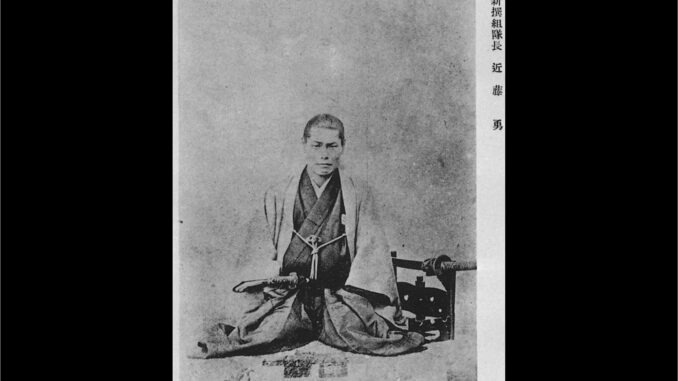
It was here that a young man named Miyagawa Katsugoro arrived, around age 15, to study under Shūsuke. He would eventually be adopted by the headmaster and take the family name — becoming Kondō Isami, 4th headmaster of Tennen Rishin-ryū, and commander of the Shinsengumi.
Kondō Isami was known for sometimes losing bouts with practice swords — but for being utterly fearless when the stakes were real. That distinction — between performance in practice and performance under genuine threat — is precisely what Tennen Rishin-ryū was built to develop.
— Tozando Historical Account of the Ikedaya IncidentIn 1863, Kondō Isami led a group of sword practitioners to Kyoto to serve the Tokugawa shogunate as a special police force. The Shinsengumi — roughly, “Newly Selected Corps” — were charged with maintaining order in a city increasingly inflamed by radical loyalist ronin seeking to overthrow the shogunate and restore imperial rule. Among its core members were four Tennen Rishin-ryū practitioners:
- Kondō Isami (1834–1868) — Commander; 4th headmaster of the school; executed after capture in 1868
- Hijikata Toshizō (1835–1869) — Vice-commander; known as “the Demon Vice-Commander”; died in the Battle of Hakodate, the last battle of the Boshin War
- Okita Sōji (1842–1868) — Captain of the 1st division; widely considered the group’s finest swordsman; entered the school at age 9, became its top practitioner by 14; died of tuberculosis aged 24–26 (depending on Japanese vs. Western age reckoning)
- Inoue Genzaburō (1829–1868) — Captain of the 6th division; one of Kondō Isami’s oldest training partners from the Shieikan dojo
The most famous single engagement of the Shinsengumi’s history was the Ikedaya Incident of June 1864: Kondō led a group of ten men into a Kyoto inn where roughly twenty to thirty loyalist ronin had gathered to coordinate a plot involving arson and attacks on shogunate forces. Armed with steel helmet and chainmail beneath his kimono, Kondō and his unit — including Okita Sōji, Nagakura Shinpachi, and Tōdō Heisuke — stormed the building. Eight loyalists were killed and twenty-three arrested. The Shinsengumi lost one man, with two more dying later of injuries. The incident made them famous throughout Japan — and made Tennen Rishin-ryū’s name alongside them.
The school’s legend was also shaped by tragedy. Okita Sōji — the prodigy who had mastered the school’s techniques by age 14 — collapsed during or shortly after the Ikedaya engagement, reportedly coughing blood. He died of tuberculosis within a few years, aged 25 or 26, never seeing the end of the war he had given his brief life to. Hijikata Toshizō fought on after the shogunate’s fall, retreating north with loyalist forces, dying in the very last battle of the Boshin War on Hokkaido in 1869. Kondō Isami was captured and beheaded in April 1868 — the only Shinsengumi commander to be formally executed by the new Meiji government.
One genuinely interesting question surrounds Tennen Rishin-ryū’s classification. We began this series with Katori Shintō-ryū, founded in 1447 and recognized as Japan’s oldest koryu school. We end with a school founded in 1789 — three and a half centuries later — that sits on the boundary between the classical and the modern.
Scholars sometimes list Tennen Rishin-ryū among shin ryūha — newer schools — rather than traditional koryu. Its embrace of shinai competition and its lack of the ancient lineage tracing that characterizes schools like Katori or Jikishinkage-ryū put it in a different category. At the same time, its transmission structure, curriculum, and philosophical orientation are unmistakably in the koryu tradition. It was built by a man who had trained in classical schools. It carries their DNA, even if it sits near the end of that lineage.
In one sense, this is the perfect note to end the series on. The ten schools we have covered represent a continuous thread from 1447 to the present — from divine inspiration at a Shinto shrine to the last desperate battles of a dying feudal order. Tennen Rishin-ryū is the hinge: one foot in the classical world, one in what came after.
- Kondō Isami, Hijikata Toshizō, and Okita Sōji are among the most enduringly famous figures in Japanese popular culture — the subject of countless novels, films, anime, manga, and video games across four generations
- The Shieikan dojo site in the Tama district of Tokyo is preserved as a historical landmark; the Kondō family gravesite in Mitaka, Tokyo draws visitors to this day
- The Ikedaya Incident (1864) remains one of the most documented and dramatized single engagements in Japanese martial history
- Two surviving lineages continue today — the Kondō line under current headmaster Hirai Masato, and the Matsuzaki line under Otsuka Atsushi — both transmitting the school’s curriculum in the Tama area of Tokyo
- The school’s emphasis on adaptable, natural response over rigid classical form anticipates the philosophical direction that modern budo (kendo, judo, aikido) would take after the Meiji Restoration
- The Kashima Shintō-ryū connection (School #2 in this series) closes a circle in our journey — the school that produced Tsukahara Bokuden also shaped the founder of this final entry
Every school in this series has survived in different ways. Katori Shintō-ryū survived through disciplined transmission across twenty generations. Jigen-ryū survived because an entire domain was trained in it. Ono-ha Itto-ryū survived through the personal dedication of a lineage that stretched from the Tokugawa court to a Methodist church in Setagaya.
Tennen Rishin-ryū survived through story. The men who practiced it died on the wrong side of history — defenders of a feudal order that the Meiji Restoration dismantled. Kondō was executed. Hijikata died in the last battle. Okita died of tuberculosis before seeing any conclusion. And yet the school — and its people — became more famous in defeat than most warriors ever become in victory.
There is something fitting about ending this series here. We began with a man who spent a thousand days in isolation to receive a divine transmission of the sword’s secrets. We end with men who carried those secrets — transformed across three and a half centuries — into the streets of Kyoto on a summer night in 1864, and changed Japan’s story by doing so. The sword shaped them. They shaped history. And the school they carried into battle is still being taught in Tokyo, in the same district where they trained, today.
This has been The Lineages That Shaped the Sword — ten schools, six centuries, one continuous thread from the oldest martial art in Japan to the men who fought for its last feudal government. Thank you for following the series. The sword tradition lives.
- — en.wikipedia.org/wiki/Tennen_Rishin-ryū. Core school details, founder biography, arts taught, and current headmasters.
- — en.wikipedia.org/wiki/Shinsengumi. Formation, key members, and Bakumatsu engagements including the Ikedaya Incident.
- — en.wikipedia.org/wiki/Ikedaya_incident. Detailed account of the 1864 engagement, casualty figures, and historical significance.
- — en.wikipedia.org/wiki/Okita_Sōji. Biographical detail including age of entry, prodigy account, and tuberculosis death.
- — budojapan.com. Practitioner account from training at Kato Kyoji’s Bujutsu Hozonkai dojo; discussion of shin ryuha classification.
- — weblog.tozando.com. Historical account of the 1864 raid including the detail of Kondo’s steel helmet and chainmail, and the characterization of his practice vs. real-combat performance.
- — jref.com. Member list and the Shieikan dojo connection to the Tama district.
- — alchetron.com. Additional detail on Kuranosuke’s founding philosophy and the school’s position between koryu and shin ryuha.
The Lineages That Shaped the Sword — ten schools, six centuries of Japanese martial history.
Read all ten posts at KenjutsuWorld.com
Thank you for following the series.
Leave a Reply